
”
You learn something everyday if you pay attention.
-Ray LeBond
The relationship between society and technology
Literacy, mainly reading and writing skills, are seen as necessary to participate within society. What role then, does digital literacy play in today’s society? While technology is permeating people’s homes, places of work and everyday lives, many are at a disadvantage when it comes to utilizing such tools. Technology must be accessible to everyone in order for people to advocate for themselves and their societies, access tools and resources, and to connect us in the global community. Technology is underutilized as a means of bridging the digital divide (Eubanks, 2007).
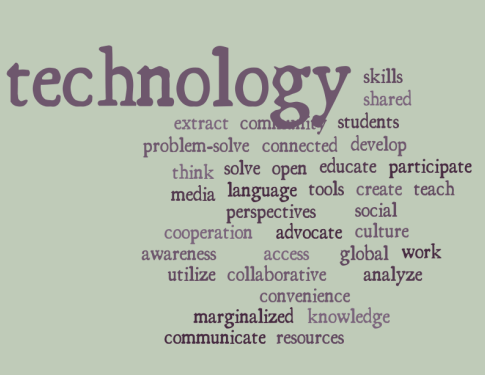
This idea becomes evident even in creating this document. When searching the term “technology” on Google images, the only people in those images are Caucasian, males in business suits. By educating people and providing them access to technology, it allows the development of social awareness in marginalized communities, so they will be better able to engage in society. Disadvantaged groups with few resources now rely on the internet to further their social movements all over the world, from the Arab Spring, the Hong Kong protests, and in the cries for justice in the shooting of Michael Brown. Technology has played an enormous role in how activists are organizing and protesting. Technology is breaking down barriers to how “networking, information sharing and coalition building” are impacting society (Petray, 2011).
The look of 21st century learning and classrooms

In many ways there is still a disconnect between the current learner population and 21st century classrooms. While learners in the U.S. have changed, many classrooms have not. “There is a mismatch between the actual world we live, learn and work in and the institutions that have been in place for the last hundred years…” and these are the places that are meant to prepare us to work in that world (Davidson, 2011). Recent studies show that children ages zero to six are spending more time on technology than they are outside. By age 21 they will have talked for 10,000 hours on a cell phone and read under 5,000 hours (Bleed, 2005). Students are often passive observers in the learning process rather than having the opportunity to problem-solve, innovate and contribute to a dynamic two-way exchange. On the other-hand, many teachers are embracing more innovative modes of instruction, including flipped-classrooms, using technology to enhance the learning experience, project-based learning, and a much more experiential approach. These educators realize that learners possess a different set of skills; thus, altering a traditional classroom structure provides students with the opportunity to take the lead and utilize technology for learning and teaching. Furthermore, through sharing resources and collaborating, teachers and students can benefit from an enormous knowledge-base. We can do so much more with others than we could do alone. For this reason, I support the open movement, as I believe collaboration leads to greater innovation. “Open educational resources are inherently scalable because they can be reused, remixed, and repurposed” (Wiley & Green, 2012). It allows educators to create and share ideas to enhance multiple modes of teaching. In such an environment, ideally the teacher is always learning and developing as they inspire this same drive in their students. In her dissertation, Couros diagrammed” The Networked Teacher” (Couros, 2009).There she illustrates all of the resources that openness allows us to access so that our time can be better spent thinking of new innovations, rather than recreating the wheel. Couros’ original illustration can be seen here. In today’s society, it is clear that learners are actively using technology that is constantly changing. With “new learners, new technologies, new workforce skills, and new modes of creative expression”, literacies in all forms must adapt to meet these new needs (Bleed, 2005). It is vital that we educate students in “authentic learning environments,” where we prepare them for the real-world, where they expand upon content by exposing students to “multiple disciplines, multiple perspectives, ways of working, habits of mind, and community.” Multi-faceted problems challenge learners to be open to multiple perspectives (Lombardi, 2007).
Institutions, and higher education in particular, are often not portraying such technologies as educational resources and equipping students with the tools to succeed in the interconnected world. Technology can be used to help students see the world around them, collaborate, analyze, see world problems, develop and sustain global cooperation, find solutions, and demonstrate critical thinking. To engage and contribute to society in the 21st century, individuals must possess the skills that are central to media literacy “contextualizing, acquiring and applying content knowledge…” (Jolls, 2014). Digital literacy skills should consistently be a focus of a student’s education. It is important to not only educate individuals, but to also meet learners where they are. Around the globe, countries are realizing the importance of education and the potential of technology to expand networks of learning. Many of those same countries are also looking at access to education, things such as affordability. Such changes in the educational landscape require schools to examine the role of technology and how it will shape such changes. Those who adapt their education systems to meet the need for such media literacy will be preparing their students “for ac tive and full participation in both their local and global villages” (Jolls, 2014).
The effectiveness of technology
Technology is necessary in the 21st century as it allows us to be globally connected, competent, accountable, professionally competitive, and equalizes the ability to access knowledge. Technology can streamline processes, increase efficiency and allow us to be more productive. Davidson urges us to consider the fact that the internet has increased efficiency, yet we feel unsatisfied with the amount we are accomplishing. The mismatch between our higher education institutions and our ‘work flow’ must be examined to rectify this imbalance (Davidson, 2011). There is no denying that technology has transformed individuals and entire societies. As John Naisbitt said:
“we are drowning in information but starved for knowledge”
and this explains some of the problems with technology. In many ways technology is still not seen as a mainstream tool for education. It divides gender, social classes, and the haves versus the have-nots. If technology can be more integrated into education and readily available for all people, if it can be viewed not just as entertainment, but as an educational tool, if we can accomplish “synchronized intelligence,” where our minds and tools are connected, the potential for what can be accomplished is endless (Gee, 2013).
Philosophy of Technology Statement:
For now these are some of my philosophies of learning and technology:
Technology allows us to access resources with ease, problem-solve, learn, exchange information, and collaborate.
- To be an effective educator, you must always be learning
- Adults must take responsibility of their own learning, problem-solving, and exploration
- To learn, adults must be active participants in the process
- In order to expand and enrich the learning process, ideas, resources, and concepts must be shared. (Technology allows us to do this)
- Provide students with the tools to continue learning outside of class and to apply what they have learned
Works Cited
Bleed, R. (2005, August). Visual literacy in higher education.
Couros, A. (2009, November). Story of an idea. Retrieved from http://couros.ca/cv/research/story-of-an-idea/ (Links to an external site.)
Davidson, C. (2011). Project classroom makeover. New York, NY: Penguin Group.
Eubanks, V. E. (2007). Trapped in the digital divide: The distributive paradigm in community informatics. The Jounal of Community Informatics, 3. Retrieved from http://ci-journal.net/index.php/ciej/article/view/293/318
Gee, J. (2013). Synchronized intelligence: getting our minds and tools in sync. In The anti-education Era: Creating smarter students , 171-191.
Jolls, T. (2014, May 1). The Global Media Literacy Imperative. Russian-Anerican Education Forum: An Online Journal , 6(1). Retrieved from http://www.rus-ameeduforum.com/content/en/?task=art&article=1001036&iid=18
Lombardi, M. M. (2007). Authentic learning for the 21st century: An overview. Educause, 1-12.
Petray, T. L. (2011). Protest 2.0: online interactions and Aboriginal activists. Media, Culture and Society, 922-940.
Wiley, D., & Green, C. (2012). Why openness in education? In Game changers: Education and IT (pp. 81-90). Retrieved from http://www.educause.edu/research-publications/books/game-changers-education-and-information-technologies (Links to an external site.)
This blog post was first published by KB for a Master’s project at Western Washington University on November 25, 2014.
 digitallyevergreen.com